The Best Marketing Plan for 2027 Starts With a “No”
There’s something strange about annual planning. Many start with a calendar that looks a lot like the year before, then spend a few hours figuring out what else we can add to it. Nobody means to do this. It just happens. The events are already there. So are the campaigns, the channels, and the annual initiatives. Then an idea gets someone excited. There’s a platform we should probably be on. A competitor is doing something interesting. Someone saw a presentation about a trend we can’t afford to ignore.
By the end of the meeting, 2027 is looking very ambitious.
But before we start adding to the 2027 marketing plan, there’s a more important question: What does the business need from marketing this year?
Maybe the answer is more leads or greater awareness. But maybe growth will come from somewhere less obvious. A different audience. A better customer experience. An underperforming market with untapped potential. A smarter way to retain customers. A partnership we haven’t considered. Or an entirely new opportunity we haven’t made room to explore yet.
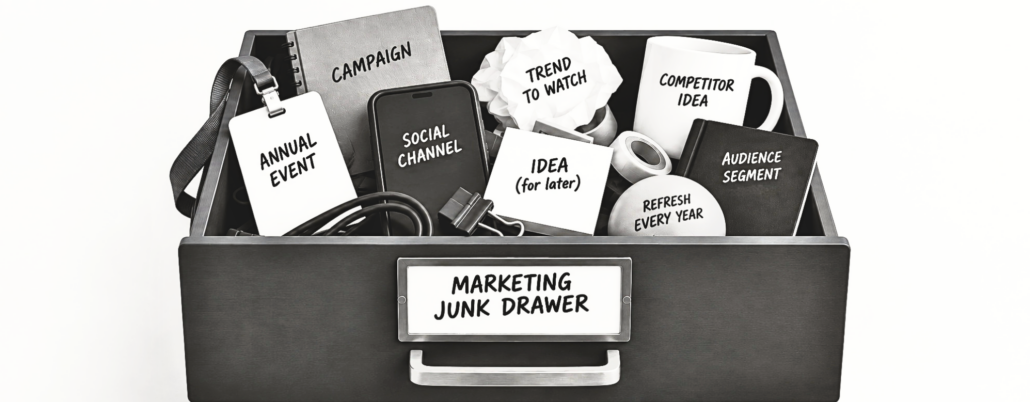
That’s where the junk drawer comes in. That’s right, marketing has a junk drawer. Things get put in it for perfectly good reasons and then somehow stay there for years. The event we always attend. The channel we keep feeding. The campaign we refresh every year. The thing everyone agrees is important, although it’s been a while since anyone asked why.
A good junk drawer isn’t empty. It holds useful things, interesting things, and a few things you forgot you had. But every once in a while, you have to clean it out. Annual planning is a pretty good time to do it. Maybe everything still belongs, but it should have to make the case. Is it helping us achieve what the business needs now? Is it performing as well as it could? Is there a better way to do it? And if we weren’t already doing it, would we choose to start?
And then AI walked into the planning meeting. Suddenly, some of the work we’ve always done for planning can happen dramatically faster. The conversation about AI in marketing has focused on how much more we can produce. But that may not be the most interesting opportunity. Competitive landscape reviews. Research synthesis. Data analysis. First drafts. Finding patterns across a mountain of information. The question is what we do with the time it gives back.
We could use it to make more stuff. Or we could use it to think. To explore an idea that never makes it to the top of the list. Dig deeper into why something isn’t working. Test something new. Spend more time with customers. Challenge an assumption. Look at the business differently.
That’s where 2027 planning gets interesting.
At TMP, we ask a lot of questions. Why are we spending money here? Why is this still on the calendar? Why are we talking to this audience? Why are we measuring this? What is the business trying to achieve? And is there a more interesting way marketing could help get us there?
Not because everything needs to go. Sometimes asking why confirms that something absolutely deserves to stay. Sometimes the answer isn’t to stop doing it at all, but to make it work harder. And sometimes it exposes the things we’re doing simply because we’ve always done them.
That’s a big part of what we do at TMP. We help teams get out of execution mode long enough to look at the whole picture, challenge assumptions, and make intentional decisions about what comes next. The best marketing plan for 2027 probably isn’t 2026 plus a few new things. It starts with the business. What are we trying to accomplish? Where could growth really come from? What deserves more attention? What could work harder? And yes, what should we stop doing to make room for something better?
Before you fill up the 2027 calendar, clean out the junk drawer. You might be surprised by what you find in there. And, if this has you rethinking what makes the cut for 2027, LET’S TALK ABOUT IT!