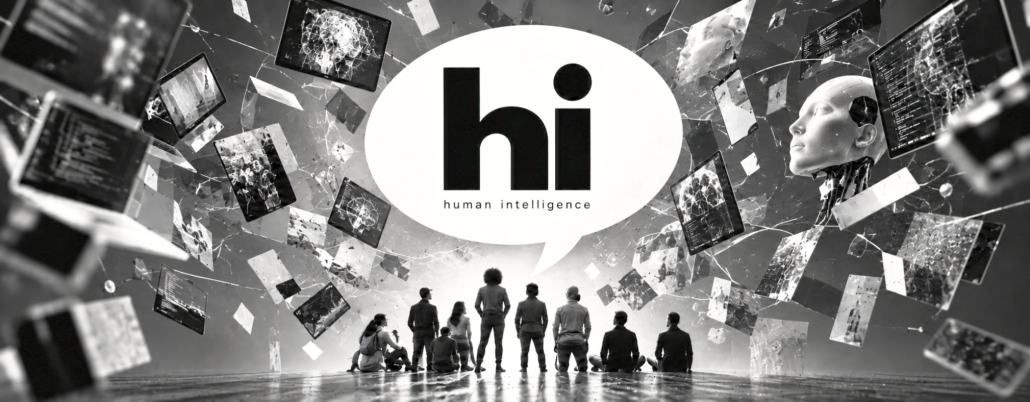
HI AI. We Still Have Something to Say.
hi: /haɪ/ acronym. Human Intelligence. The shortest distance between two people.
noun. The opening move. The moment before anything has happened, when everything still can.
acronym. HI: Human Intelligence. The source material for every story ever told, and now for every machine being taught to tell one.
phonetics. One syllable, one breath. The sound rises as you say it, which feels fitting somehow.
etymology. Older than language, probably. First expressed with an open hand.
Hi. Here it is: a little optimism.
Marshall McLuhan said every medium is an extension of ourselves. The wheel extends the foot, the book the eye, the circuit the nervous system. I’ve carried that idea with me through most of my career, and I’ve been thinking about it a lot again lately because it cuts through some of the anxiety around AI.
Technology has never really arrived from somewhere else. We make it. We build tools to reach a little farther, move a little faster, make something easier, or make something possible that wasn’t before.
Artificial intelligence may be the most intimate version yet. The wheel copied movement. AI copies language, and language carries almost everything we are. Centuries of people explaining things, selling things, consoling each other, arguing, joking, persuading, teaching, writing badly, writing beautifully, and trying to make themselves understood.
Whatever else AI is, it isn’t foreign. It’s made from us.
I started my career at the last threshold that felt anything like this one. Dennis Interactive in New York. Modem Media in Connecticut. Digitas and Publicis. This was the late nineties, when the web was still more idea than infrastructure and nobody really knew what the rules were because, for the most part, there weren’t any yet.
And we were having conversations that sound almost ridiculous now. What should a homepage do? How much should be on it? What does someone click first? How do you make something feel interactive without making it annoying? We were making it up as we went, which was frustrating sometimes and incredibly fun most of the time.
There was plenty of fear around the internet then too. It was going to isolate people. Destroy industries. Cheapen creativity. Put people out of work. Some of those fears weren’t entirely wrong. Technology always changes things, and some of those changes do hurt.
But the bigger story, at least from where I sat, was that far more people got access to tools that used to belong to a relatively small group. More people could make things, publish things, build businesses, find an audience, and (my favorite), they could have a voice.
I came out of that period trusting technology less than I trusted what people would eventually figure out how to do with it.
Marketing is about to find out whether that trust still holds.
AI is pushing the cost of making things toward zero. Copy, images, video, versions, adaptations, forty markets, forty formats. Things that used to take days can happen in minutes.
That changes the value equation.
If almost anything can be produced, then producing it is no longer the interesting part. The harder part is knowing what should be made in the first place. Knowing something true about people before the brief is written. Seeing the thing everyone else missed. Having enough taste and judgment to look at a hundred decent options and know which one is actually worth putting into the world.
And I don’t think the flood of machine-made content makes human intelligence less valuable: I suspect it does the opposite. The more average work there is, the easier it becomes to recognize someone who actually has a point of view.
AI can make a lot of average work very quickly, we already know that.
But it can also make a smart person faster. It can help someone explore more directions, get past the first obvious answer, make versions that would once have eaten up half a day, or spend less time on the mechanical parts of the job.
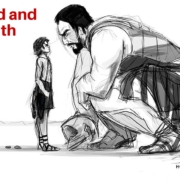
Science fiction has spent decades giving us stories about replacement. Humans versus machines is a much better plot than humans using another tool, so I get why we keep going back to it.
But our history with tools is mostly less dramatic than that. They change what we’re able to do, and then we adjust. Certain skills matter less. Others suddenly matter more. Jobs change. New ones show up. People complain. Then, eventually, whatever seemed strange becomes normal enough that we stop noticing it.
I don’t see HI and AI as opposites. One came from the other.
Whether machines can talk was probably never the interesting question anyway.The better question is whether we’ll still have something to say. I think we will.
Hi, human intelligence. We literally got this.
Written by Kenyon Weiss, Chief Creative Storyteller at The Marketing Posse.